How Are Large Language Models Supporting Natural Language Processing Applications?
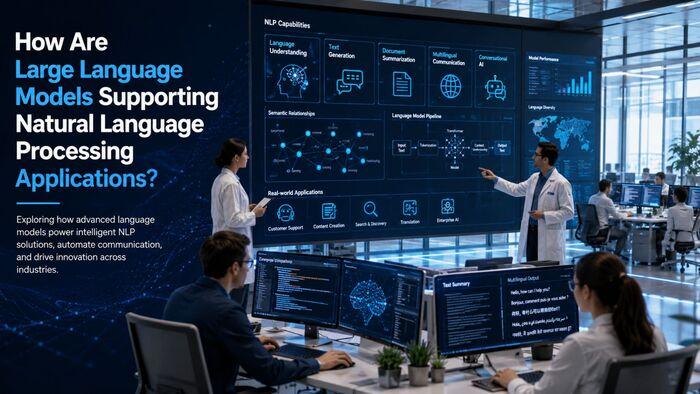
The rapid advancement of artificial intelligence has significantly transformed how computers understand and generate human language. Organizations across industries are adopting intelligent language technologies to automate communication, improve customer experiences, and streamline information management. Large language models have become a foundational technology within natural language processing (NLP), enabling machines to interpret context, generate meaningful responses, summarize complex documents, and assist with language-based tasks. These advanced AI systems are helping businesses improve efficiency while expanding the capabilities of digital applications. As demand for intelligent communication continues to grow, large language models are playing an increasingly important role in powering next-generation NLP solutions that support innovation across healthcare, education, finance, customer service, and enterprise operations.
Understanding Natural Language Processing with AI
Natural language processing enables computers to understand, interpret, and respond to human language in ways that feel increasingly natural. Modern NLP systems support applications such as virtual assistants, automated translations, document analysis, chatbots, and intelligent search platforms. The accuracy of these applications has improved considerably through advances in machine learning and deep neural networks. Large language models contribute to this progress by learning language patterns from extensive datasets. They recognize context, understand relationships between words, and generate coherent responses that improve communication between humans and machines. As organizations continue expanding digital services, NLP technologies are becoming essential components of business operations and customer engagement strategies.
Key Benefits of Large Language Models
Organizations continue investing in large language models because they provide valuable capabilities that improve both business operations and user experiences.
Key Benefits Include:
- Improved natural language understanding
- Faster document summarization
- More accurate conversational AI
- Enhanced multilingual communication
- Intelligent content generation
- Greater operational efficiency through automation

These advantages help businesses build scalable NLP applications while supporting innovation across a wide range of digital services.
How Large Language Models Improve AI Applications
The growing capabilities of AI surveillance demonstrate how artificial intelligence extends beyond language processing into intelligent decision-making across multiple industries. Similarly, large language models enhance NLP applications by improving text generation, information retrieval, language translation, summarization, and conversational experiences with greater accuracy and contextual understanding. Businesses increasingly integrate these models into customer support platforms, internal knowledge systems, and productivity tools to automate repetitive communication tasks while maintaining high-quality interactions. By reducing manual workloads and improving response consistency, organizations can deliver faster and more personalized services that strengthen customer satisfaction and operational efficiency.
The Future of Intelligent Language Technologies
Artificial intelligence continues evolving toward more connected and adaptive business ecosystems. Just as marketing funnels organize customer interactions into structured stages that improve engagement, future NLP technologies will increasingly organize information, conversations, and business knowledge into more intelligent communication workflows.

Emerging developments may combine language understanding, predictive analytics, multimodal AI, and autonomous decision support to create highly personalized digital experiences. Organizations that adopt responsible AI practices while embracing intelligent language technologies may improve collaboration, increase productivity, and strengthen long-term digital transformation strategies.
You can also watch : Globussoft: Transforming Businesses with AI-Powered Solutions & Next-Gen Technology
Conclusion
Natural language processing has become a critical component of modern digital experiences, enabling organizations to communicate more effectively through intelligent automation. By improving language understanding, contextual reasoning, and conversational capabilities, large language models are transforming how businesses interact with information and customers. As artificial intelligence continues advancing, organizations that strategically integrate language models into their operations may achieve greater efficiency, innovation, and customer engagement across an increasingly connected digital world.
FAQs
What are large language models?
Large language models are advanced AI systems trained on extensive datasets to understand, generate, summarize, and analyze human language for various applications.
How do large language models support natural language processing?
They improve language understanding, conversational AI, translation, summarization, search, and content generation by recognizing context and producing meaningful responses.
Which industries use large language models?
Healthcare, finance, education, customer service, legal services, software development, marketing, and enterprise operations increasingly use large language models to automate communication and improve efficiency.
.jpg)
.jpg)
.jpg)
Comments